


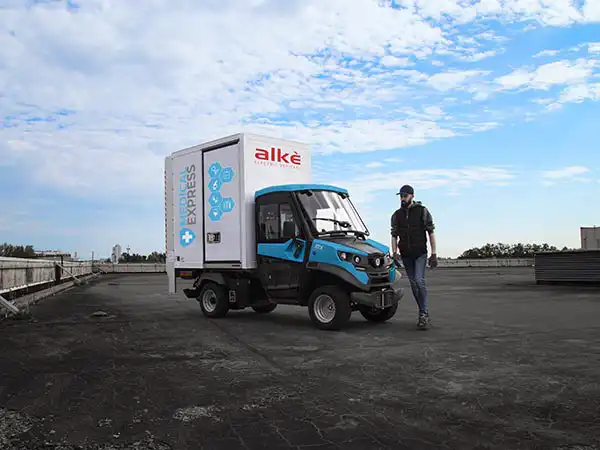

Electric vehicles for research institutes and chemical-pharmaceutical industry
Alkè electric vehicles are also used by research institutes, laboratories, universities and within the chemical-pharmaceutical industry, where operational precision, reliability, and the absence of noise and pollutant emissions are decisive factors.
Why should you choose an electric vehicle for research institutions?
- Zero emissions and silent operation
- Customisation and modularity
- Extremely compact and manoeuvrable
- Also ideal for indoor use
- Low running costs

Reliability and flexibility for research institutions and the chemical-pharmaceutical industry
Alkè vehicles are distinguished by their ability to adapt to a wide range of applications. Research institutes and companies in the chemical-pharmaceutical industry require transport solutions that guarantee quietness, zero emissions, manoeuvrability in confined spaces and a high load capacity. The logistics platforms in these environments, which are often complex and subject to strict safety protocols, require the use of versatile and reliable vehicles. Precisely in this context, Alkè vehicles prove ideal: they are homologated for road circulation, but are also perfectly efficient in indoor environments, thanks to the absence of emissions and low noise levels. The most popular versions include specific fittings such as the platform with opening tail lifts, the enclosed box and the tail lifts with hydraulic tail lifts, which meet the most diverse logistical requirements. Alkè electric vehicles offer a combination of high performance, versatility and safety, making them ideal for demanding professional environments such as research laboratories and chemical-pharmaceutical plants. Alkè electric vehicles have a maximum chassis load capacity of 1630 kg and a towing capacity of 4500 kg. These capacities allow the safe transport of heavy and bulky materials, such as scientific equipment or chemical containers. Alkè vehicles provide a range of up to 200 km. The braking energy recovery system helps optimise energy efficiency, which is particularly useful in environments with frequent stop-and-go. The vehicles can be equipped with a Vehicle Body Computer that allows real-time monitoring of operational data, facilitating fleet management and preventive maintenance.

- agile, manoeuvrable vehicles that are also suitable for indoor use
- load capacity up to 1630 kg (chassis)
- towing capacity up to 4500 kg
- versatile and reliable vehicles

Electric vehicles for research institutions and the chemical industry: most popular fittings
Dropside body with openable sides. The platform with openable sides is one of the most popular solutions for material handling in science centres, research centres and chemical/pharmaceutical production facilities. This type of vehicle allows easy side loading and unloading, ideal for distributing samples, reagents, or scientific equipment between departments and laboratories. The sides can be lowered and raised with a simple gesture, making operations quick and safe. In addition, the sturdy frame construction allows significant loads to be transported while maintaining stability and control. Closed box. Where protection of the transported material is required, the enclosed box set-up is the most suitable choice. This is particularly useful in the pharmaceutical sector, where the sensitivity of products to environmental conditions (light, temperature, contamination) is a central issue. Alkè closed boxes can be made of insulated materials or equipped with refrigeration systems where required, ensuring that ideal conditions are maintained during transport. In addition, they can be locked to ensure the security of the contents, which is also relevant in research centres where sensitive samples or expensive instruments are handled. Tail lift and dropside body with mesh sides extension. For the transport of bulky or particularly heavy materials, the equipment with mesh side extensions and tail lift is the most suitable. The mesh side extensions increase the vehicle containment capacity, while the tail lift facilitates loading and unloading, avoiding manual lifting and reducing the risk of injury. This is particularly useful in warehouses or storage areas for hazardous or delicate materials, where every movement must be controlled and tracked.
- dropside body with openable sides for material handling
- closed box for material protection
- mesh side extensions to increase loading volume
- tail lift to facilitate loading and unloading

Benefits for research institutions and the chemical-pharmaceutical industry
Zero emissions and silent operation. One of the main advantages of Alkè vehicles is their fully electric operation. This means zero emissions and no noise, which is essential in closed environments such as university campuses or chemical plants. Quiet operation is particularly appreciated in research centres where the concentration of operators and the absence of noise interference are important for carrying out activities. Low running costs. Alkè electric vehicles have lower maintenance and operating costs than conventional vehicles with combustion engines. The lower mechanical complexity and the absence of engine oil, air filter and coolant result in fewer interventions and greater reliability in the long term. This is particularly relevant for public authorities or companies that manage large fleets and need to ensure operational efficiency with limited budgets. Customisation and modularity. A further strong point of Alkè vehicles is the possibility of customising the equipment according to the customer's specific needs. The company offers a wide range of modular configurations that make it possible to transform a single vehicle into a multi-purpose platform, thus reducing the overall number of vehicles required for different operations.

Cod. DR1 - Loading bed
Designed to meet the needs of a wide variety of sectors
DR1


Cod. DR2 - Dropside body with storage box
The storage box is a safe storage element and combines perfectly with the loading floor.
DR2


Cod. BV2 - Box van body
Useful for transporting materials and equipment for in-house maintenance.
BV2


Cod. TL2 - Tail lift and box van body
In case protection of the transported material is required.
TL2


Cod. TL1 - Tail lift and mesh sides extension
It facilitates the loading and unloading of materials from the dropside body, reducing physical effort.
TL1

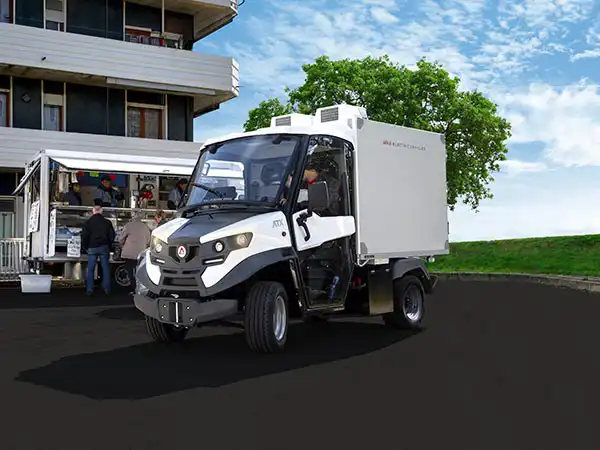
Cod. IS1 - Van with isothermal body
This is the ideal option if you need to transport temperature-controlled goods.
IS1

